
By the Metago Health Editorial Team | Reviewed by a certified diabetologist | Updated June 2026
| Key Takeaways |
| • Both Ozempic (semaglutide) and Trulicity (dulaglutide) are once-weekly GLP-1 injections approved for type 2 diabetes. Evidence shows semaglutide produces greater HbA1c and weight reductions head to head. |
| • Semaglutide carries a stronger cardiovascular outcomes label (26% MACE reduction in SUSTAIN-6); dulaglutide also reduces MACE risk and may suit patients with a lower CV risk profile. |
| • Both are Schedule H prescription-only drugs in India. Your doctor’s guidance, not a comparison article, should drive the final decision. |
If your doctor has mentioned Ozempic or Trulicity, you are in the right place.
This guide walks through six key differences between the two drugs, grounded in published clinical trial data, so you can have a better-informed conversation with your healthcare provider.
1. What Are Ozempic and Trulicity, and How Do They Work?
Ozempic and Trulicity belong to the same drug class: GLP-1 receptor agonists (glucagon-like peptide-1 receptor agonists). Both mimic a natural gut hormone that your body releases after eating.
When they bind to the GLP-1 receptor, they trigger three core effects: they stimulate the pancreas to release insulin in a glucose-dependent way, slow gastric emptying to reduce post-meal blood sugar spikes, and signal the brain to reduce appetite.
The active ingredient in Ozempic is semaglutide, developed by Novo Nordisk. Trulicity’s active ingredient is dulaglutide, developed by Eli Lilly.
Both are injected once weekly under the skin, and both are indicated for adults with type 2 diabetes mellitus as an adjunct to diet and exercise.
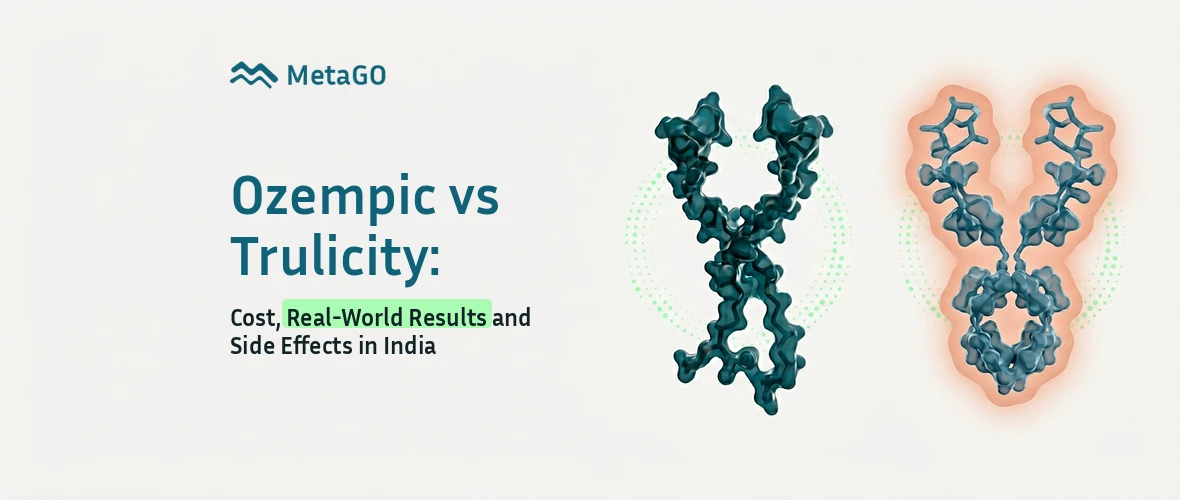
Where the two drugs differ is in their molecular architecture, and that difference has measurable clinical consequences.
Semaglutide shares 94% sequence homology with native human GLP-1, with three structural modifications that extend its half-life to approximately 165 hours (about 7 days). A fatty acid side chain promotes strong albumin binding, dramatically reducing renal clearance.
Dulaglutide takes a different route to longevity. It consists of two modified GLP-1 molecules covalently linked to an IgG4 Fc fragment, a region of an antibody.
This large molecular size delays renal clearance and produces a half-life of approximately 5 days. REWIND trial design. The Lancet, 2019.
In practical terms, both achieve stable once-weekly dosing. The structural difference, however, may partly explain why semaglutide consistently outperforms dulaglutide on efficacy endpoints in head-to-head trials.
2. Which One Lowers Blood Sugar More Effectively?
The clearest answer comes from SUSTAIN 7, a head-to-head phase 3b randomised controlled trial published in The Lancet Diabetes and Endocrinology in 2018.
It is the only large trial that directly compared semaglutide and dulaglutide at matched dose levels in patients with inadequately controlled type 2 diabetes on metformin.
After 40 weeks of treatment:
| Dose Comparison | HbA1c Reduction (Semaglutide) | HbA1c Reduction (Dulaglutide) | Outcome |
|---|---|---|---|
| Low dose | −1.5% (0.5 mg/week) | −1.1% (0.75 mg/week) | Semaglutide superior |
| High dose | −1.8% (1.0 mg/week) | −1.4% (1.5 mg/week) | Semaglutide superior |
Both reductions are clinically meaningful. An HbA1c drop of 1.0% or more is associated with significantly reduced risk of microvascular diabetes complications. SUSTAIN 7 trial. Lancet Diabetes Endocrinol. 2018.
The AWARD clinical trial programme, which investigated dulaglutide across multiple studies, reported a mean HbA1c reduction of 1.28% across AWARD-1 through AWARD-10, with treatment durations of 24 to 52 weeks.
Real-world data from Spain found reductions ranging from 0.5% to 2.2% across studies of 3 to 24 months. ScienceDirect observational study on dulaglutide vs semaglutide. 2021.
The long-term cardiovascular outcomes trial REWIND tracked 9,901 patients on dulaglutide over a median follow-up of 5.4 years and found an HbA1c reduction of 0.61% compared to placebo.
This reflects a lower-baseline population, not a ceiling of the drug’s capability. REWIND trial. The Lancet, 2019.
For patients whose primary goal is maximum HbA1c reduction, the evidence consistently favours semaglutide.
That said, both drugs achieve levels of glycaemic control well above placebo, and your doctor’s choice will also factor in your baseline HbA1c, other medications, and cardiovascular risk.
3. Which One Helps With Weight Loss More?
Weight management is a central concern for most people managing type 2 diabetes in India, where visceral obesity and metabolic syndrome are increasingly prevalent.
Both drugs reduce body weight, but the magnitude of difference between them is substantial.
In SUSTAIN 7, patients on semaglutide 0.5 mg lost an average of 4.6 kg over 40 weeks, compared to 2.3 kg with dulaglutide 0.75 mg.
At the higher dose, semaglutide 1.0 mg produced a loss of 6.5 kg, versus 3.0 kg with dulaglutide 1.5 mg. SUSTAIN 7. Lancet Diabetes Endocrinol. 2018.
For patients with obesity, the STEP 1 trial tested semaglutide at 2.4 mg weekly (the Wegovy formulation) and found a mean weight loss of 14.9% of body weight over 68 weeks, compared to 2.4% with placebo plus lifestyle intervention. 86% of participants achieved at least a 5% reduction in total body weight. STEP 1 trial. NEJM, 2021.
| Drug | Approved Doses (Weekly) | Mean Weight Loss (Trial) | Weight Loss Approval |
|---|---|---|---|
| Ozempic (semaglutide) | 0.5 mg, 1.0 mg, 2.0 mg | 4.6–6.5 kg (SUSTAIN 7) | Type 2 diabetes only |
| Wegovy (semaglutide) | Up to 2.4 mg | ~14.9% of body weight (STEP 1) | Obesity management |
| Trulicity (dulaglutide) | 0.75 mg, 1.5 mg, 3 mg, 4.5 mg | 2.3–3.0 kg (SUSTAIN 7) | Type 2 diabetes only |
Dulaglutide also produces weight loss. Higher doses (3.0 mg and 4.5 mg) studied in AWARD-11 showed meaningful reductions, particularly in patients with higher baseline BMI.
Real-world evidence confirms weight benefits, but the average loss remains consistently lower than comparable semaglutide doses.
For patients requiring the greatest possible medically supervised weight reduction beyond what semaglutide achieves, tirzepatide (Mounjaro), a dual GIP/GLP-1 receptor agonist now available in India, demonstrated up to 20.9% average body weight reduction in the SURMOUNT-1 trial — surpassing both semaglutide and dulaglutide.
Neither Ozempic nor Trulicity is specifically approved for weight management as a standalone indication in India. Wegovy (semaglutide 2.4 mg), approved by the DCGI, is indicated for obesity. Talk to your doctor about which formulation is most appropriate for your goals.
4. Which One Has Stronger Heart-Protective Evidence?
Heart disease remains the leading cause of death in people with type 2 diabetes. Both Ozempic and Trulicity have been tested in dedicated cardiovascular outcomes trials, and both have demonstrated meaningful cardiovascular benefits.
The evidence is stronger for semaglutide in high-risk populations.
Semaglutide’s cardiovascular case rests on SUSTAIN-6, a two-year randomised trial in patients with type 2 diabetes and high cardiovascular risk.
Semaglutide reduced the risk of major adverse cardiovascular events (MACE, defined as cardiovascular death, non-fatal myocardial infarction, or non-fatal stroke) by 26% compared to placebo (HR 0.74; 95% CI 0.58–0.95; p = 0.02). SUSTAIN-6. NEJM, 2016.
Dulaglutide’s cardiovascular evidence comes from REWIND, a longer and broader trial. It enrolled 9,901 patients across 24 countries over a median follow-up of 5.4 years.
Crucially, only 31.5% of REWIND participants had established prior cardiovascular disease, making the findings applicable to a wider population including those with cardiovascular risk factors rather than established disease.
Dulaglutide significantly reduced the composite MACE endpoint compared to placebo. REWIND. The Lancet, 2019.
| Trial | Drug | Population | Follow-up | Key CV Finding |
|---|---|---|---|---|
| SUSTAIN-6 | Semaglutide | High CV risk;>68% prior CVD | ~2 years | MACE reduced by 26% |
| REWIND | Dulaglutide | Broad CV risk;31.5% prior CVD | 5.4 years | MACE significantly reduced vs. placebo |
A 2025 propensity score-matched real-world analysis in Scientific Reports found that semaglutide was associated with significantly lower all-cause mortality and cardiovascular events compared to dulaglutide. Comparative CV outcomes of semaglutide vs dulaglutide. Scientific Reports, 2025.
If you have established heart disease, your doctor may lean toward the drug with the stronger MACE label.
If you are at earlier-stage cardiovascular risk, dulaglutide’s REWIND profile may still be highly relevant. This is a conversation worth having with your cardiologist or endocrinologist.
5. How Are They Dosed and Injected?
Both drugs are injected once weekly under the skin of the abdomen, thigh, or upper arm. Neither requires injection into a muscle or vein.
You can take both with or without food, and you can administer them at any time of day, as long as the day remains consistent week to week.
Ozempic (semaglutide) dosing: Treatment begins at 0.25 mg once weekly for 4 weeks. This is a titration dose, not a therapeutic dose.
At week 5, it escalates to 0.5 mg weekly. If additional glycaemic control is needed and the dose is tolerated, your doctor may increase to 1.0 mg at week 9, and further to 2.0 mg weekly in some patients.
Ozempic also has an oral tablet formulation (Rybelsus) for patients who prefer not to inject.
Trulicity (dulaglutide) dosing: The starting dose is 0.75 mg once weekly. After at least 4 weeks, this can be increased to 1.5 mg weekly if needed. Higher doses of 3.0 mg and 4.5 mg are available in some markets and have been studied in AWARD-11. Trulicity is available only in injectable form.
| Feature | Ozempic (Semaglutide) | Trulicity (Dulaglutide) |
|---|---|---|
| Starting dose | 0.25 mg weekly (titration) | 0.75 mg weekly |
| Maintenance dose | 0.5 mg to 1.0 mg weekly | 0.75 mg to 1.5 mg weekly |
| Maximum approved dose | 2.0 mg weekly (injectable) | 4.5 mg weekly (select markets) |
| Oral formulation available? | Yes (Rybelsus, daily tablet) | No |
| Pen type | Reusable multi-dose pen (1 mg pen; 2 mg pen) | Single-use pre-filled autoinjector pen |
| Injection frequency | Once weekly, same day | Once weekly, same day |
| Missed dose window | Up to 5 days after scheduled day | If 3+ days remain before next dose |
The Trulicity pen is often cited as easier to use for injection-naive patients, since it is a single-use autoinjector that does not require attaching a needle.
Ozempic uses a dial-dose pen that requires NovoFine needles. For many patients, the device experience is as important as the clinical data when it comes to long-term adherence.
6. What Side Effects Should You Watch For?
Because both drugs work by the same mechanism, their side effect profiles overlap significantly. Gastrointestinal (GI) symptoms are the most commonly reported adverse events for both, particularly during the dose escalation phase.
Common Side Effects (Both Drugs)
Most GI side effects emerge in the first 4 to 8 weeks of treatment and tend to improve as the body adjusts.
| Side Effect | Semaglutide (SUSTAIN 7 data) | Dulaglutide (SUSTAIN 7 data) | Notes |
|---|---|---|---|
| Nausea | 21–22% | 13–20% | Most common; improves over time |
| Diarrhea | 13–14% | 8–18% | Dose-dependent with dulaglutide |
| Vomiting | 9–10% | 4–10% | Higher with semaglutide at low dose |
| Constipation | 4–5% | 3–5% | Less common, generally mild |
At low doses, semaglutide may cause slightly more nausea than dulaglutide. At higher doses, the GI burden becomes more comparable between the two.
Discontinuation due to GI adverse reactions with Ozempic injection was 3.1% to 3.8% in placebo-controlled trials, versus 0.4% for placebo. Ozempic safety profile. Novo Nordisk prescribing information.
Serious Risks to Know About
Both drugs carry a boxed warning for the potential risk of thyroid C-cell tumours, based on animal studies.
This risk has not been confirmed in humans, but both drugs are contraindicated in patients with a personal or family history of medullary thyroid carcinoma or Multiple Endocrine Neoplasia type 2 (MEN2).
- Pancreatitis: Acute pancreatitis has been reported with GLP-1 receptor agonists. Stop the medication and contact your doctor immediately if you experience severe, persistent abdominal pain.
- Diabetic retinopathy: SUSTAIN-6 noted a higher incidence of diabetic retinopathy complications with semaglutide (3% vs 1.8% for placebo). Patients with pre-existing retinopathy should be monitored closely.
- Gastroparesis: Postmarketing data show an association between semaglutide and gastric motility problems. Ozempic is not recommended in patients with severe gastroparesis.
- Hypoglycaemia: Severe hypoglycaemia is uncommon with either drug as monotherapy. Risk increases when combined with insulin or sulfonylureas. Incidence of severe hypoglycaemia was under 1.5% across Ozempic placebo-controlled trials.
- Kidney effects: Both drugs are generally associated with protective kidney effects, though dehydration from GI side effects can worsen kidney function. Report any significant vomiting, diarrhoea, or reduced urination to your doctor.
7. How Available Are These Drugs in India?
The Indian GLP-1 landscape changed significantly in early 2026. Both drugs are prescription-only (Schedule H) under the Drugs and Cosmetics Act, 1940, and require a valid prescription from a registered medical practitioner.
Semaglutide (Ozempic) in India
Semaglutide received DCGI approval and has been available in India under the Ozempic brand (Novo Nordisk) for type 2 diabetes.
Following the expiry of Novo Nordisk’s core Indian patent on 20 March 2026, multiple Indian pharmaceutical companies launched DCGI-approved generic versions.
Within days of patent expiry, brands from Dr. Reddy’s Laboratories (Obeda), Zydus Lifesciences (Semaglyn, Mashema, Alterme), Alkem Laboratories (Semasize, Obesema), Sun Pharma (Sematrinity, Noveltreat), and others entered the market.
By April 2026, over 40 DCGI-approved generic semaglutide brands were in circulation in India. Pearce IP. Generic Semaglutide Launches in India. 2026.
Wegovy (semaglutide 2.4 mg for obesity) also has DCGI approval. All generic semaglutide products contain the identical active molecule as branded Ozempic and have been approved after comparison studies.
Differences across brands lie in delivery device format (vial vs. pre-filled pen vs. reusable pen) and manufacturer.
Dulaglutide (Trulicity) in India
Trulicity (Eli Lilly) is available in India through pharmaceutical distributors and specialty pharmacies as a prescription-only import medication. For a complete guide to Trulicity covering dosage, injection technique, and side effects, see our complete Trulicity guide.
It is available in the 0.75 mg and 1.5 mg pre-filled single-dose pen presentations.
Higher doses (3 mg and 4.5 mg) may require special access. Availability may vary across cities.
Real-world Indian studies involving over 700 patients have confirmed dulaglutide’s HbA1c-lowering and weight benefits in the Indian population, with a mild-to-moderate GI adverse event profile consistent with global data.
| Ozempic / Semaglutide | Trulicity / Dulaglutide | |
|---|---|---|
| DCGI Status | Approved | Available on prescription import |
| Indian generics available? | Yes (40+ brands, from March 2026) | No (brand name only) |
| Prescription requirement | Schedule H (mandatory) | Schedule H (mandatory) |
| Oral formulation in India | Yes (Rybelsus / generic oral) | No |
| Where to access | Endocrinology clinics, major pharmacies | Specialty distributors, select hospital pharmacies |
Never purchase either medication without a valid prescription. Both are Schedule H drugs and should only be initiated and managed under medical supervision.
Do not switch between brands or formulations mid-treatment without consulting your doctor.
| The Bottom Line |
| The evidence consistently shows that semaglutide (Ozempic) produces greater reductions in HbA1c and body weight than dulaglutide (Trulicity) at matched doses, and carries a stronger cardiovascular outcomes label in high-risk patients.Dulaglutide remains a well-validated, effective, once-weekly option with a broad cardiovascular safety profile across a wider risk spectrum. The best drug for you depends on your HbA1c level, cardiovascular history, weight goals, injection preference, and other medications. Consult a diabetologist or endocrinologist, or explore the MetaGo weight loss program, to determine which GLP-1 receptor agonist is right for your health profile. |
Frequently Asked Questions
Is Ozempic better than Trulicity for weight loss?
Based on current clinical evidence, yes. In the SUSTAIN 7 head-to-head trial, semaglutide produced roughly twice the weight loss of dulaglutide at comparable doses over 40 weeks.
For obesity management specifically, the higher-dose Wegovy formulation of semaglutide has demonstrated up to 14.9% mean body weight reduction in the STEP 1 trial.
Trulicity is not approved for weight loss as a primary indication. For a detailed molecular comparison of the two drugs, see our semaglutide vs dulaglutide guide.
Can I take Ozempic or Trulicity if I do not have diabetes?
Wegovy (semaglutide 2.4 mg), not Ozempic, is approved by the DCGI for weight management in adults with obesity.
Ozempic and Trulicity are specifically indicated for type 2 diabetes mellitus as adjuncts to diet and exercise.
Off-label use requires a doctor’s clinical judgment. Do not initiate either medication without medical supervision.
Which has fewer side effects: Ozempic or Trulicity?
At low doses, Trulicity may cause less nausea than Ozempic. At higher doses, the GI side effect burden becomes more comparable.
Both drugs cause similar rates of nausea, diarrhoea, vomiting, and constipation, predominantly during the dose escalation phase.
Most patients find that GI symptoms improve significantly after the first 4 to 8 weeks. Talk to your doctor about slow titration strategies if side effects are a concern.
Are Ozempic and Trulicity available without a prescription in India?
No. Both Ozempic (semaglutide) and Trulicity (dulaglutide) are classified as Schedule H medications under India’s Drugs and Cosmetics Act, 1940, and legally require a valid prescription from a registered medical practitioner.
Purchasing or consuming either drug without a prescription is both illegal and medically unsafe. CDSCO has undertaken enforcement actions against pharmacies dispensing GLP-1 medications without valid prescriptions.
What happens if I miss a dose of Ozempic or Trulicity?
For Ozempic, if you miss a dose and the next scheduled dose is more than 5 days away, take the missed dose as soon as possible.
If it is within 5 days of the next scheduled dose, skip the missed dose and resume your regular schedule.
For Trulicity, take the missed dose if your next dose is at least 3 days (72 hours) away. Do not take two doses in the same week for either medication.
| Medical DisclaimerThis article is intended for general informational purposes only and does not constitute medical advice. Ozempic (semaglutide) and Trulicity (dulaglutide) are prescription-only medications under Schedule H of India’s Drugs and Cosmetics Act, 1940. Both require a valid prescription from a registered medical practitioner. Do not start, stop, or switch any medication without consulting your doctor. Individual responses to treatment vary, and only a qualified healthcare professional can determine the most appropriate therapy for your specific health profile. |